

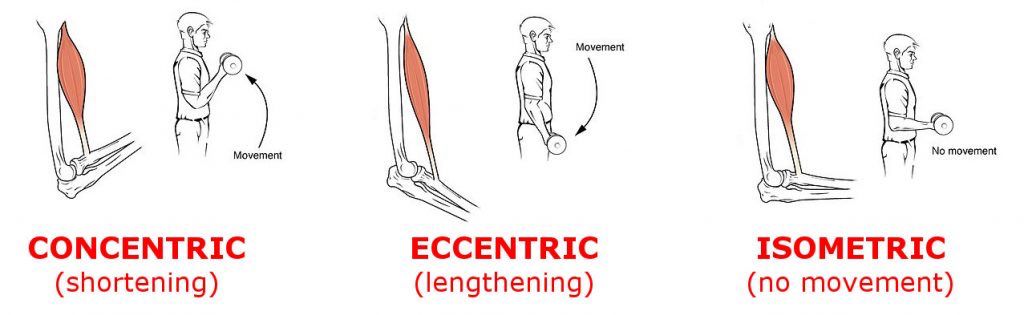
Muscle action modalities are represented as (i) isometric muscle actions, which involve no change in muscle length, (ii) concentric muscle actions, which involve shortening of muscle tissue, and (iii) eccentric muscle actions, which involve active lengthening of muscle tissue against an external force or load.
During concentric contractions, the tension of the muscle increases until resistance and remains stable as the muscle shortens. During eccentric contractions, on the other hand, the muscle lengthens as the resistance gradually becomes greater than the force the muscle can produce
Interestingly, it is the eccentric or negative phase of a strength training repetition that will give you the most bang for your buck if you know how to utilize this phase properly.
In direct comparison, eccentric muscle actions can produce greater force, estimated to be 20-60% greater than the force produced during concentric activities. Evidence of muscle damage (loss of force production, increased painetc. are routinely reported on a larger scale when eccentric actions are completed.
Eccentric strength training with submaximal, maximum (100% maximum) repetitions [1RM]) or supramaximal (typically 105-120% 1RM) training loads have been shown to stimulate greater increases in maximal muscle strength during traditional activities involving both concentric and eccentric actions compared to traditional types of strength training.
One of the first research observations on eccentric muscle actions was studied by Fick in 1882, when he discovered that a contracting muscle when stretched could produce a greater force than a shortening muscle contraction. About fifty years later, AV Hill (who became a Nobel Prize winner) found that the body required less energy during eccentric muscle action than during concentric muscle action.
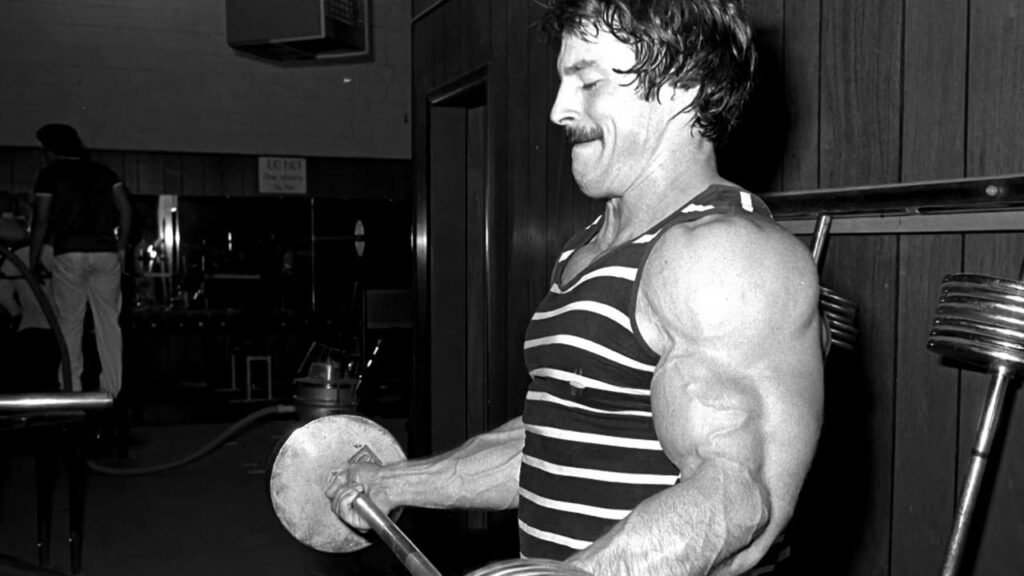
Nautilus founder Arthur Jones and the legendary Mike Mentzer, as well as many HIT proponents, were big proponents of eccentric training and incorporated slow eccentric exercises into their training sessions quite often.
A 2017 meta-analysis study found that, on average, eccentric training resulted in a greater increase in hypertrophy compared to concentric training (10.0 vs. 6.8%, respectively). However, the hypertrophic benefit of eccentric training was relatively small. Given that the maximum strength of eccentric exercise is approximately 20-50% higher than that of concentric exercise, it can be speculated that the greater workload of eccentric exercise may be responsible for differences in muscle growth.
A 2008 meta-analysis found that eccentric training may be associated with greater improvements in both overall and eccentric strength compared to concentric training in healthy individuals. Additionally, eccentric training appeared to be more effective in promoting overall muscle mass gain. The effectiveness of eccentric training in promoting strength gains may be mediated by the ability to achieve higher forces during eccentric muscle actions.
A 2022 systematic review of 18 studies found that eccentric training is an effective method for changes in muscle architecture, leading to improvements in both lower limb flexibility and strength.
Although both concentric and isometric muscle contractions produce a hypertrophy response, numerous studies have reported that eccentric actions may have the greatest impact on skeletal muscle growth. Here are the benefits of eccentric training:
- Importantly, some studies suggest that the speed of eccentric action may preferentially impact hypertrophic changes. Additionally, eccentric training has been shown to result in increased hypertrophy in both pure concentric and pure eccentric strength.
Slower eccentrics are certainly beneficial, but too slow have not shown any particular benefits. A 2022 study examined the effects of changing the duration of the eccentric phase on muscle hypertrophy and quadriceps femoris strength. Ten healthy young adults (8 men and 2 women) performed a unilateral knee extension exercise with each leg randomly assigned to the eccentric phase of movement lasting either 2 seconds or 4 seconds.
The study concluded that both 2-second and 4-second eccentric durations produced similar improvements in total muscle hypertrophy and lower limb strength. The larger TUT in 4 seconds was not a critical modulator in altering general muscle adaptations. The slower eccentric duration showed a positive effect on hypertrophy of the vastus medialis muscle, suggesting that different eccentric duration may help promote favorable muscle growth in this area of the quadriceps femoris.
- With eccentric exercise, greater power output is mainly produced during a maximal eccentric action due to the ability to use higher external loads.

- Furthermore, the The energy expenditure for eccentric training is comparatively lowDespite the high muscle force generated, you expend less energy in the eccentric phase of the movement than in the concentric. This makes eccentrics an attractive strategy for those looking to build additional strength and hypertrophy, as more volume can be performed without undue fatigue
- Eccentric training is also associated with greater robustness Increasing protein synthesis as well as one greater increase in IGF-1 compared to concentric muscle actions.
- Elicit eccentric training sessions greater muscle damage compared to concentric training. The degree of eccentrically induced muscle damage is greater in the muscles of the upper extremities than in the lower extremities.
- There is also evidence that there may be a fiber type-specific response to muscle damage Type II (fast-twitch) muscle fibers appear to be more susceptible to damage during eccentric exercise as type I (slow-twitch) muscle fibers.
Eccentric training, particularly eccentric overload, has been shown to result in greater recruitment of motor units, particularly fast-twitch muscle fibers, as well as faster force development, resulting in a greater amount of mechanical tension generated throughout the muscle.
These improvements, along with changes in the elastic properties of the muscle-tendon unit, contribute to increases in speed, strength and power. Additionally, eccentric training has been shown to improve an athlete's movement efficiency because they are better able to absorb potential energy in the eccentric phase of movement and then train concentrically
- Integrating eccentric training and programming into a strength training program can enable numerous benefits that go well beyond simple increases in strength and hypertrophy, for populations ranging from athletes seeking elite performance to clinical patients undergoing physical rehabilitation.
For example, the aging process leads to a progressive and continuous decline in muscle strength. For this reason alone, the inclusion of eccentric training in the elderly could be considered, as it is known to improve muscle strength and power while reducing the risk of falls and potential fracture risk.
A 2022 meta-analysis study found that eccentric training is superior to, or at least as good as, concentric training for maintaining the health and overall function of older adults.

Eccentric focused exercises are often prescribed as a rehabilitation method to treat a range of injuries, particularly overuse injuries, including the rehabilitation of tendinopathies, muscle strains, and anterior cruciate ligament (ACL) injuries in which you have chronic inflammation or pain in the soft tissue surrounding your muscles and joints. Eccentric training has been shown to be a highly effective method for improving soft tissue size and quality, reducing pain in affected limbs, and improving return to playing success.
Research has shown that eccentric training is an effective method for reducing new and recurrent injuries. Most injuries in sports occur eccentrically during deceleration movements. If we cannot handle the force we want to absorb eccentrically, the body compensates for the load, which can then lead to injury. It is logical that if we have the eccentric strength to handle larger forces, we are less likely to sustain injuries, as our muscles grow longer and we improve the quality of our connective tissue.
- In terms of increasing strength, eccentric exercise training plays an important role in all sports where jumping, running or throwing is a crucial part of the stretch-shortening cycle, and has been proven to be an effective method for increasing (explosive) muscle strength and muscle cross-sectional area.
- Studies have also found that eccentric training has the same effects in men and women.
There are many ways to incorporate eccentric training into your schedule, but the simplest and most commonly practiced technique is the Super Slow technique. The lifter performs an exaggerated slow speed eccentric phase while lifting the bar concentrically and explosively.
Athletes should try to think of their muscles as giant braking systems that slow down resistance. And the greater the range of motion during the exercise, the longer the lowering time.
Slow and controlled eccentric repetitions help the muscle stay under tension for longer. When the muscle fibers contract, they continue to stretch.
Training by resisting force in the eccentric portion of an exercise. Avoid letting the weight return to the starting position for as long as possible. By intentionally increasing the time the muscle is exposed to this load, you can help your clients produce more force and build more strength over time.

It should be emphasized that the eccentric duration varies depending on the load used. For example, a lower % 1RM will give a longer eccentric duration (i.e. 60% 10-12 seconds), whereas a higher load (ie 85%) would likely give an eccentric action duration of around 4 seconds. Typically, a load in the range of 60 to 85% of 1RM is used with an eccentric action duration of 2 to 15 seconds, depending on the load assignment, type of movement, size of the muscle group, etc. A rest period of 60 seconds is commonly used.
To further increase the intensity, you can also ask a spotter/partner to assist with the concentric portion of the rep at the end of the set and you lower the bar yourself.
However, because eccentric training increases DOMS, one should avoid using near-maximal or maximal eccentric muscle contractions when designing training programs for inexperienced clients.
