

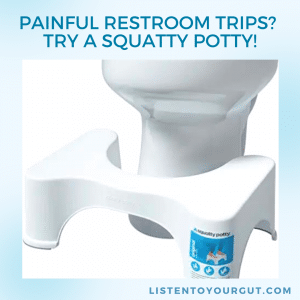
 In Jini’s blog post, Natural Treatment for Rectal Prolapse, she explains that the Western practice of sitting on the toilet prevents the rectum from erecting and opening – making us much more susceptible to prolapse, constipation, hemorrhoids and anal fissures! It’s best to squat on the toilet or use a squatting platform like the Squatty Potty that fits around your toilet.
In my experience, using a Squatty Potty can literally be a life-saver – not only for general well-being, but also for times when I personally struggle with constipation, hemorrhoids, etc. But before I get into why we love squatty potties, let’s talk a little bit about why the position in which you go to the toilet is so important.
Check out WebMD’s explanation:
“Stool remains in your rectum – a collection chamber at the end of your large intestine. A U-shaped muscle called the puborectalis encloses your rectum. This muscle keeps the lower part of your intestine flexed to hold the stool in until you are ready to go. It works similarly to a bend in a garden hose that prevents water from escaping. The slight bend in your colon prevents you from letting go and having an accident. When it’s time to have a bowel movement, your rectum contracts. The puborectalis muscle relaxes and you push to release the stool from your body.
The problem with sitting is that it maintains the kink in the lower abdomen. This forces you to work harder to get the poop out. Squatting causes the puborectalis muscle to relax more and straightens the colon so that feces have a straight path out. This allows you to move forward more easily and with less effort.
X-rays taken as part of studies show that the rectum becomes more erect when squatting. The pressure in your stomach is also less in this position, which could be a sign that you are not pushing yourself as hard.
Studies show that people squat faster when they use posture-altering devices. They also strain less and empty their bowels more completely than when sitting on the toilet. By making defecation easier, squatting can relieve constipation and prevent hemorrhoids, which are often a result of overexertion.”
So if you look at it from a purely physical perspective, you may be blocking these muscles without doing squats! This makes this tool just as important (in my opinion) as any of Jini’s other tools. If you can relax your stomach, rectum, and body, you have the best chance of eliminating toxins in a healthy way—which can relieve pain and help you heal.
Because proper detoxification is essential, and one of the best ways to achieve that is number two. 😉
 Jini and her family are also fans of the Squatty Potty! In one of Jini’s most valuable (and popular) YouTube videos, “Constipation Pooping Positions,” Jini uses a squatty potty to demonstrate the different positions you can use to make bowel movements easier.
The Squatty Potty can also help with scars and cracks. Personally, I have had cracks and some scarring in my rectum which are very painful – so finding a little relief with the Squatty Potty was much needed and grateful. If you have tears or scars that have formed and caused strictures or blockages, relaxing and positioning the rectum correctly can definitely help things go more smoothly and reduce pain when you go to the bathroom.
Each of us with IBD usually has some form of fear of going to the bathroom or trauma from past experiences, such as extreme pain or not getting to the bathroom on time. Having something like a squatty potty that can relieve some pressure can actually help release some of your trauma as you are now replacing that experience with a new and hopefully more positive one.
Knocking on the toilet
Have you ever sat on the toilet in agony? You are not alone! I’ve been there countless times, so I’d like to share with you a technique I began practicing while sitting that helped relax my mind, body, and muscles – which usually resulted in less strain and pain. I personally have benefited greatly from Jini’s Lazer Tapping because this therapy teaches you and allows you to be your own healer!
Lazer Tapping is based on EFT tapping, which I have also been practicing for years. It is Jini’s own highly simplified technique, combined with access to the wisdom of the body itself – the actual consciousness of the body’s cells and tissues – and it is the cornerstone of her healing from widespread Crohn’s disease.
Jini describes it like this:
Lazer Tapping, EFT, TFT and other acupressure tapping methods stimulate the acupuncture meridian points on the body. Traditional Chinese Medicine (TCM) assumes that energy (Chi, Ki, Prana) flows through the body along energy pathways – similar to how blood flows through arteries.
Now imagine that this network of energy paths is three-dimensional. to connect every organ, every bone, every cell, every tissue, every atom, every emotion, every belief, every mind and every feeling into a single grid. The meridians are the paths along this 3D grid or network, and along the meridians are individual portal points. These are the acupressure tapping points. The acupressure meridians are the connection between the visible and the invisible.
How cool is that?!
You can find out more aHere’s why Jini loves tapping and how it was the foundation for her healing. You can also attend a FREE session with her, which I highly recommend! The free session that helped me the most in these situations was called “Release emotions in your gut that cause physical symptoms.”
Another technique that has helped me relax in the bathroom is meditation! Jini’s guided healing meditation is one of my favorite meditations. In it, she guides you through breathing and visualization techniques to bring you into deep relaxation. Then, once you are deeply relaxed, you can visualize or imagine what in your body needs healing – be it constipation and/or pain relief, increasing blood flow, wound healing, etc.
 If you have pain on the toilet, why not give it a try? Incorporating one (or all!) could potentially help relieve pain and trauma that may be blocking the release of responses. Additionally, tapping or meditating doesn’t have to be limited to time on the toilet. It’s also helpful to knock beforehand – this way you can release the trauma before using the toilet.
I would try practicing these relaxation techniques when I didn’t have to run to the bathroom. This way, when I had to walk, I was in a more relaxed state – which usually meant less pain. I also went through the problems in my head so I wouldn’t panic. For example, every time I went to the toilet I saw a toilet full of blood, which made me even more panicked. And panicking doesn’t help anyone!
By tapping before going to the bathroom, and by tapping despite these feelings of fear and anxiety, I was finally able to see blood and not panic – which also eased the pain. This was in addition to Jini’s physical protocols and of course consulting with my doctor!
Whether it’s breathwork, EFT tapping, emotional expression (or whatever technique you choose), Jini advises both exploring the awareness of the trauma/pattern/belief and actually getting into the cells and tissues. So whatever therapy you do, make sure it’s accessing and integrating both layers because that way you’re actually releasing it from the body so it’s not stuck there and held in place. I go into this in a little more detail in my blog post “Unwinding” – How to release trauma from the body.
Travel and stylish squatty potties
I love Squatty Potties so much that I actually travel with one when my destination doesn’t offer it. Amazon offers many collapsible squatty potties that fit in your luggage. I found it pretty easy to travel with them as they are thin when folded!
I recently did some research on different types of squatty potties, and there are a lot of them, but I absolutely fell in love with one called Tushy! You may have heard of Tushy as they also offer installable bidets (which are great too!). Tushy’s Ottoman Toilet Stool ($69) is so stylish that I was able to leave it out and not have to hide it when company came over! 🙂
The only downside is that the Tushy doesn’t fold up, so it has to stay stationary – but it’s so cute, I was okay with that! They offer a relaxed version or an original for the squat, which I think is really cool.
Squatty Potty itself also offers a few different versions based on style, functionality, etc., and these are slightly cheaper than Tushy:
Squatty Potty Simple Toilet Stool ($16)
Squatty Potty Original ($25)
Squatty Potty Fold N Stow ($25) – compact and foldable! They also offer it in bamboo ($50)
Squatty Potty “Flip” ($30) – alternating 7″ stool and 9″ stool. They also offer it in bamboo ($34)
They even have a motion activated one that lights up and options for kids too!
Squatty Potty Tips!
#1) In this video, Jini demonstrates her colon massage on a bed, but it can also be done over the toilet if necessary! Here too, elevating your knees to relieve pressure when sitting on the toilet, as well as tapping, meditating or massaging can help provide relief.
#2) Measure your toilet! It’s important to get a squatty potty that fits your toilet. When I moved, I measured the new space to make sure I had one with the height I needed. To find out what height you need, sit on the toilet and squat down. Wherever you feel comfortable, you should take a tape measure and measure. Then try to find a Squatty Potty or Tushy that fits that body size.
My final point is…
Once you have one, a Squatty Potty, you will find that you can’t live without it!! Does anyone here use a squatty potty yet? Do you love yours as much as I do? Write a comment below!
Until next time – happy recovery and remember to always listen to your gut. 🙂

Linsy is Jini’s assistant. From a highly sensitive/reactive case of ulcerative colitis to a fully medical and surgical treatment using all-natural methods, Linsy truly understands first-hand the interplay of mind/body/spirit on the healing journey.
