

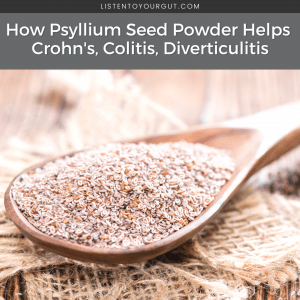
Psyllium Seed Powder vs. Psyllium Seed Husk Powder: What’s the Difference?
 I formulated ColonEaze~Firm with only psyllium seeds and ColonEaze~Move with a beneficial psyllium seed to psyllium husk ratio of 2:1.
Why is this important and what is the difference between psyllium seed powder and psyllium husk powder?
This document explains the key differences and the benefits of each. I have picked out the most important points for you here:
“The anaerobic fermentation of the soluble non-starch polysaccharides from psyllium seeds leads to the production of the short-chain fatty acids acetate, propionate and butyrate in the intestine.
Psyllium husks only contain the epidermis of the seed, while the actual seed has a higher proportion of fermentable fiber.
Because of this fiber content, psyllium breaks down more slowly than pectin and produces relatively large amounts of butyrate and acetate.
Butyric acid exhibits antineoplastic activity against colon cancer, is the preferred oxidative substrate for colonocytes, and may be helpful in the treatment of ulcerative colitis.
In a study of patients with resected colon cancer, those given 20 grams of psyllium daily for three months showed an average 42 percent increase in butyric acid production, which returned to pre-treatment levels within two months of stopping supplementation.”
The role of butyric acid in intestinal health
The intestines use butyric acid as an anti-inflammatory agent. Butyric acid therefore benefits people with intestinal diseases such as ulcerative colitis, diverticulitis and Crohn’s disease, as this short-chain fatty acid helps restore the integrity of the intestinal lining while reducing inflammation.
“In an open-label, randomized, multicenter study of individuals with ulcerative colitis, psyllium supplementation (10 grams twice daily) was as effective as mesalamine in maintaining remission. This effect may likely be due to increased butyric acid levels with psyllium supplementation. (1)”
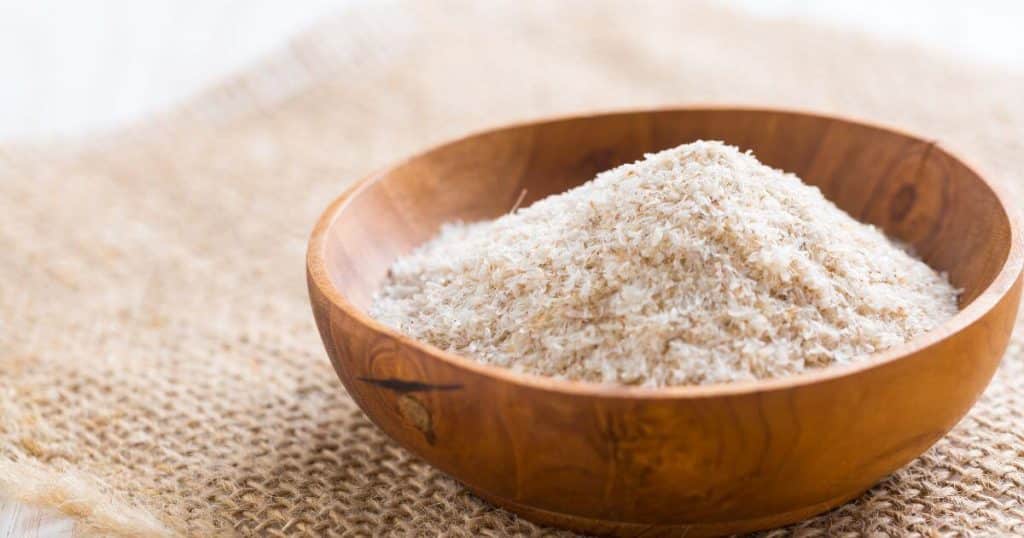
Psyllium and psyllium husks bulk up the stool (attract/hold water if your stool is too hard, or bind the feces into a stool if your stool is loose or watery), exercise the colon, balance peristaltic rhythms, help produce butyrate, and simultaneously serve as food for probiotics. All of this contributes to the healing/maintenance of the integrity of the colon lining.
Due to psyllium’s ability to bulk up stool, it is also a valuable detoxifying agent, helping to eliminate toxins, dying substances, or dead pathogens.
According to the above study, since psyllium is a soluble fiber, it is easier for colon bacteria to ferment and therefore leads to a higher production of butyrate/butyric acid. So butyric acid is the result of beneficial bacteria fermenting the soluble fiber from psyllium powder; The probiotics feed on this and produce butyrate.
How psyllium and psyllium husks promote intestinal health
However, the 30% insoluble fiber in psyllium husk is helpful in moving stool through the intestinal tract (it is a great bulking agent and is indigestible). You want this to happen when you are constipated. However, if you suffer from diarrhea, you should not stimulate bowel movements.
That’s why ColonEaze~Move contains both psyllium husks and psyllium seeds; but ColonEaze~Firm only contains psyllium seeds.
If you are prone to constipation, you can also combine ColonEaze~Move with 1 tbsp. Psyllium husk powder, with 1 tbsp. Bentonite clay for short-term, targeted detoxification.
However, I recommend you don’t use bentonite for longer than 2-3 weeks as it adsorbs all the bacteria in the gut – which reminds me: make sure you take your probiotics far away from your bentonite clay!

For example, take ColonEaze/Psyllium Husk and Bentonite in the morning and afternoon and lastly take your probiotics before bed.
If your bowel movement time is already short, you may respond better to psyllium seeds than psyllium husks mixed with bentonite clay.
Detoxification with psyllium seeds: eliminate toxins
The other really important thing to know about fillers like psyllium, chia, flax, etc. is that you need to start with a small amount and gradually increase it to the recommended dosage.
Psyllium causes major changes in your colon. It doesn’t matter that the changes are beneficial. You still need to give your gut time to adjust to the increased rate of butyrate, clearance and detoxification of pathogens, and a change in stool consistency and peristalsis.
Otherwise, you may experience bloating and bloating until your intestines get used to it. So it’s best to start slowly and have a more pleasant experience.

You should definitely take probiotics to maximize the benefits of butyric acid. However, make sure you take your probiotics far away from your psyllium seeds. For example, my assistant Linsy – who has repeatedly used BCPH (bentonite clay psyllium husk) for detoxification and is super sensitive. Find it works best to use this schedule:
Probiotics – wait 20 minutes
Breakfast – wait 2 hours
Anti-pathogens – wait 20 minutes
BCPH – 1 hour wait
Lunch
References and sources
(1) Source: Fernandez-Banares F, Hinojosa J, Sanchez-Lombrana JL, et al. Randomized clinical trial of Plantago ovata seeds (fiber) versus mesalamine for maintaining remission in ulcerative colitis. Am J Gastroenterol 1999;94:427-433.
(2) Does psyllium provide insoluble fiber?
https://healthyeating.sfgate.com/much-soluble-insoluble-fiber-per-day-6686.html
https://www.intechopen.com/chapters/78644

Jini Patel Thompson is an internationally recognized expert in natural healing for digestive diseases. She healed herself from widespread Crohn’s disease and has been medication and surgery free for over 25 years. Jini has appeared on numerous podcasts, TV and radio shows in the US, UK, Canada and Australia, giving people hope and vision on how to heal their colitis, Crohn’s disease, diverticulitis and irritable bowel syndrome (IBS) using all-natural methods. Her books on natural healing of digestive diseases have been sold in over 80 countries worldwide. Jini is married and has three children, nine sheep, 11 horses, a cat and three dogs.
