


 Most yogurt culture recipes advise you to start with some store-bought yogurt and use that as a fermentation culture for your milk. Of course this will work and yogurt will be produced, but what will the quality and effectiveness of this yogurt be? as a probiotic? Not very good. Strong probiotic strains are much more expensive than the cheaper strains – yet the cheaper strains still produce a nicely thickened yogurt. So which ones do you think manufacturers will use?
I think if you’re going to get down to work and make your own yogurt, you might as well get a powerful probiotic at the same time! For this reason I use Natren’s yogurt starter. It also makes a very delicious yogurt – the same yogurt that Natren’s founder supplied to the royal families of Bulgaria and England for generations. And yes, we can order this for you from LTYG Shoppe – all you have to do is ask us two weeks before your order.
Here are the detailed yogurt recipe instructions straight from Natren:
To make yogurt, you can use cow, goat, sheep, soy, coconut or almond milk. Once you’ve mastered the method, it usually takes less than 30 minutes to make your own potent, probiotic yogurt!
equipment
- Natrens yogurt starter
- 2 liters (or two liters) milk or plant milk (do not use milk powder)
- Thermometer (temperature range 110° – 200° / 40° – 95°)
- 2 – 3 liter water bath with lid* or yoghurt maker
*If your double boiler or pan is oven safe and has a tight-fitting lid, you do not need a separate utensil. Although the casserole does not technically have to be “oven safe,” these types of casseroles are preferred because they are better insulated and retain heat longer.
If you don’t own a yogurt maker, there are many methods that can be used for incubation. The oven method is the simplest and most convenient. Incubation in the oven can be done at night while you sleep. The oven is turned off and only provides an isolated place for the yogurt bacteria to ferment. If you have an electric stove, wrap the pan in a towel. If you have a gas stove with a pilot light, place the pan on the top rack at the back. Centuries before gas and electric heat sources, people were very innovative when it came to incubating yogurt. Be creative! When your oven is running, wrap the pan in a towel and place it in a small insulated chest or wrap the container with a heating pad.
Let’s get started
Read the instructions before you begin. Gather your gear and see how easy it is to make delicious, healthy yogurt.
1. HEATING THE MILK
To avoid burning, heat the milk in a double boiler or water bath. Use a container made of stainless steel, glass or enamel. Heat the milk to 82-88°C (180-190°F) for 20 to 40 minutes for a gourmet result. Low-fat and fat-free milk must be heated for the full 40 minutes. DO NOT heat the milk in the microwave.
For faster yogurt
Heat the milk to 88-93°C (190-200°F) for 5 to 10 minutes. Be careful not to let the milk boil. In this first step, the protein molecules in the milk are broken down and a lot of water evaporates. It also kills existing bacteria. The longer the milk cools, the thicker and tastier the final product will be.
2. COOLING THE MILK
The milk must be cooled to 43-46°C (110-115°F) before adding the yogurt starter. This is important so that the bacteria thrive and the yogurt sets properly. The cooling process of the milk can be accelerated by placing the pot in cold water (be careful not to splash water into the milk). You can also stir the milk to speed up cooling. This takes about 10 minutes.
3. ADD THE STARTER
Use 1 to 2 level teaspoons of Natren’s Yogurt Starter. Place the starter in an empty cup and pour about 2 tablespoons of the cooled 43 – 46 °C milk into the starter and stir until a smooth paste forms. Continue adding milk to the paste, mixing thoroughly after each addition until the cup is almost full. Gently stir this mixture back into the pot of cooled milk and mix thoroughly.
4. INCUBATION/CULTURING
Yogurt Maker: Follow manufacturer’s instructions for incubation.
Oven method: Gas oven – place on the top rail at the back.
Electric oven: Wrap the container with a towel before placing it in the oven. Usually it is enough to turn on the oven light to provide the right temperature for preparing yogurt.
It’s best to remove the yogurt once it’s set to retain sweetness. Check after 6 hours. If you are incubating overnight, take the yogurt out of the oven when you get up in the morning and place it in the refrigerator.
How do you know when it’s yogurt?
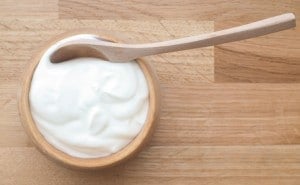
The yogurt is ready when it has thickened and has a pudding-like appearance – or pulls away from the edge of the container. If a longer incubation period is required, check every 15 to 20 minutes. The yogurt will thicken a little while it cools in the refrigerator.
Note: If you want to make sure all the lactose in the yogurt has been “digested,” let it culture for 24 hours.
TYPES OF MILK
Whole milk produces a sweeter, thicker, and creamier yogurt. Low-fat and fat-free milk can be used, but the fat-soluble vitamins A, D, E and K are depleted and the yogurt becomes slightly more sour and tangy. With goat’s milk, you may get a runnier yogurt because the protein to fat ratio is different than cow’s milk. Goat milk also contains more natural anticoagulants. You can add a 6-ounce can of evaporated milk or a heaping tablespoon of fat-free goat’s milk powder (mix in blender to remove lumps). Soy milk, coconut milk and almond milk can also be used.
COOLING AND STORAGE
When the yogurt is solid, place it in the refrigerator and let it sit for several hours until it has completely cooled. A watery deposit forms at the top – this is whey – do not stir it in, but pour it off or spoon it off. If you want, you can save it and use it to lacto-ferment your mayonnaise or vegetables.
Finished yogurt can be kept for at least 10 days. It’s not a good idea to add anything to yogurt during storage as this can reduce the beneficial bacteria and cause fermentation. As the yogurt matures, it becomes more sour and tangy. It is 100% natural, contains no stabilizers or preservatives, and has not been pasteurized after cultivation (which allows commercial yogurt to remain artificially sweeter for longer). If you plan to make yogurt cheese or ranch salad dressing or a dip from the yogurt, do so within 10 days – before the yogurt becomes too sour.
USING YOGURT IN COOKING
Yogurt is a wonderful, low-calorie, low-fat substitute for sour cream, cream cheese and other dairy products. More and more recipes are replacing high-fat cheese with yogurt. Try replacing cream cheese with yogurt cheese in your favorite cheesecake. Use yogurt instead of sour cream on potatoes, in dressings, sauces and marinades. Yogurt cheese is very easy to prepare. Simply hang plain yogurt in cheesecloth over a bowl, let the whey drain for 12-36 hours and store in the refrigerator. Yoghurt cheese can be kept for several weeks. In our test kitchen, if after a week we haven’t used all of the yogurt and it starts to go sour, we extend its shelf life by making yogurt cheese.
TROUBLESHOOTING
There are many variables that can affect the outcome of your yogurt: timing, humidity, drafts, age or quality of your milk, etc. Don’t be discouraged if you don’t get a solid set the first time. Try again, it’s worth it. You can use the unhardened yogurt at any time for baking, soups or sauces.
Too liquid?
Heat the milk sufficiently to denature the protein and natural inhibitors (as well as any antibiotic residues).
The temperature of the milk should be between 43 and 46°C (110 – 115°F) when the starter is added.
If it is cold outside, preheat your utensils with warm water.
Aluminum utensils can have a negative impact on your finished yogurt.
The temperature of your heat source should be constant.
Test your oven temperature. If your oven is too cool, use a heavier pot or gently preheat and then turn off. Do not place yogurt in an oven above 100°F (49°C).
Do not heat in the microwave.
Do not start with reconstituted powdered milk.
Too lumpy?
The starter must be thoroughly mixed into the cooled, pre-treated milk.
Only use the recommended amount of yogurt starter. If you use too much starter, the bacteria will condense and form lumpy yogurt – too little yogurt starter will not thicken the yogurt.
Original post February 2015. Last updated July 2020.

Jini Patel Thompson is an internationally recognized expert in natural healing for digestive diseases. She healed herself from widespread Crohn’s disease and has been medication and surgery free for over 25 years. Jini has appeared on numerous podcasts, TV and radio shows in the US, UK, Canada and Australia, giving people hope and vision on how to heal their colitis, Crohn’s disease, diverticulitis and irritable bowel syndrome (IBS) using all-natural methods. Her books on natural healing of digestive diseases have been sold in over 80 countries worldwide. Jini is married and has three children, nine sheep, 11 horses, a cat and three dogs.
