

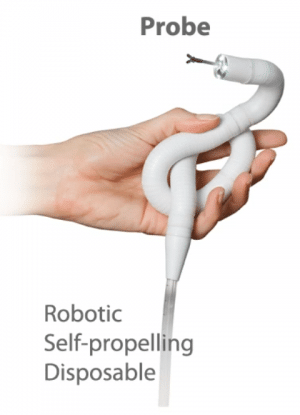
I find this hard to believe…but after spending the last ten years talking about how it’s not possible to sterilize colonoscopes; Educating people about the risks and what you can do before and after to minimize the risks. I just found out that there is FINALLY a disposable product. DisposableRobotic colonoscope, available and currently in use in Italy and Switzerland.
Of course I had to go to the blog straight away and tell you about it!
The endotic movement system initially emerged from observing how geometer moth larvae (also called caterpillars) move. The Endotics probe moves along the colon by mimicking the movement of the caterpillar worm. Apparently this reduces the pain enormously or eliminates it completely. This is also why your colonoscopy may take longer because it goes gently around your colon – rather than someone ramming a garden hose up your butt. Wait. What – did I just write that? Can you tell me that my first and last colonoscopy was a pretty unpleasant experience?
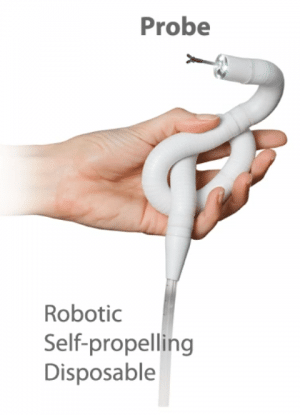 But back to the super exciting news: The entire device is a sterile disposable unit. As a professor said to a friend of mine, “We started with the disposable scalpel and now everything is disposable except for the one instrument that we inserted into the dirtiest part of the body.”
Next time your doctor suggests a colonoscopy, send them to this blog post or to the company’s YouTube channel, which contains a series of videos showing you how the robotic colonoscope works and showing samples from colonoscopies and biopsies performed.
The insider guide
You may be wondering how I found out about this new colonoscope when not too many other people, doctors, etc. know about it… Well, as you know, my books are sold to 80 different countries and this blog gets pretty high rankings, so I’m often contacted by scientists and doctors.
Let’s just say I have a lot of friends. And this special friend not only operated this disposable robotic colonoscope, he also experienced a colonoscopy using the device. Here’s what he has to say about it:
- The single-use factor is exactly what you expect. The infection transmission rate is theoretically zero. Remember that there are still people involved and normal infection control procedures still apply.
- Each device has microscopic grooves where pathogens could hide. When examining patients with special illnesses, hospitals can take their conventional colonoscope out of use for days and subject it to special cleaning. This is an indication of how seriously they take the risk of infection, but also that these risks of infection are very real.
- When operated by a competent doctor, the device is generally painless. I have experienced this firsthand as an unsedated patient. There was a slight discomfort, but nothing that I would describe as “painful.” However, I have an uncomplicated gastrointestinal tract.
- The biggest hurdle for implementation is the training period. Colonoscopists should perform approximately 50 supervised procedures to achieve competency. But especially at the beginning, when a procedure takes longer, this means that many days are lost for the examination. For an experienced traditional endoscopist, it seems frustrating to become a beginner again. In busy treatment rooms there are always time constraints and this may result in learners retrying to operate the Endotics device like a traditional endoscope (for example by pushing and turning), which can slow down the pace of learning.
- Price can also be a factor. The cost per probe is relatively high (it will decrease as production volume increases) and this is slowing adoption. When you consider the anesthetics, the cleaning staff, the cleaning machines, the cleaning chemicals, and the need for a treatment room for traditional endoscopy, the Endotics system actually performs well, but it’s difficult to get people to compare costs in this way.
What about the effectiveness?
 The aim of this clinical study was to evaluate the efficiency of polyp detection with endotics compared to conventional colonoscopy. The conclusion was that Endotics “allows visualization of the entire colonic mucosa with good sensitivity/specificity for lesion detection in most patients.”
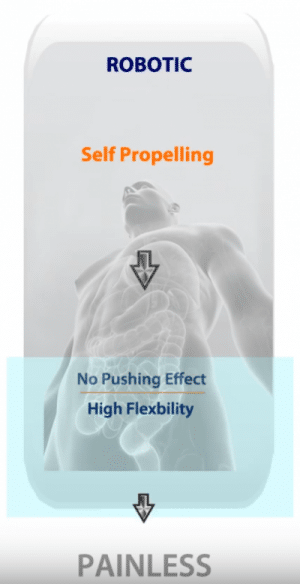
Although the procedure takes longer than a traditional colonoscopy (because it is much gentler), this study showed that “all patients rated robotic colonoscopy as virtually painless compared to standard colonoscopy and rated pain and discomfort at 0.9 and 1.1, respectively, on a scale of 0 to 10, versus 6.9 and 6.8 for the standard device.” Furthermore – and this is very important – “robotic colonoscopy showed a higher diagnostic accuracyas, due to the lower insufflation rate, it was able to visualize small polyps and angiodysplasias that were not visible with standard colonoscopy.”
I find it SO interesting that all of the research, including the manufacturer’s poster at the world’s premier GI conference, Digestive Disease Week (DDW), did NOT emphasize the key, spectacular differentiator that this device is sterile and disposable!
But we all know how terribly careful you have to be when presenting something that questions big pharma/medical companies. And if they draw attention to the problem of lack of sterility, there is a chance that a mega-corporation will destroy them. Those of you who have been reading my blog for over a decade may remember when a company in Israel invented a disposable colonoscope cover, which I was really excited about… and next thing you know, the company was bought by a large American company and the cover was never seen/heard of again. I’m just saying it.

Jini Patel Thompson is an internationally recognized expert in natural healing for digestive diseases. She healed herself from widespread Crohn’s disease and has been medication and surgery free for over 25 years. Jini has appeared on numerous podcasts, TV and radio shows in the US, UK, Canada and Australia, giving people hope and vision on how to heal their colitis, Crohn’s disease, diverticulitis and irritable bowel syndrome (IBS) using all-natural methods. Her books on natural healing of digestive diseases have been sold in over 80 countries worldwide. Jini is married and has three children, nine sheep, 11 horses, a cat and three dogs.
