
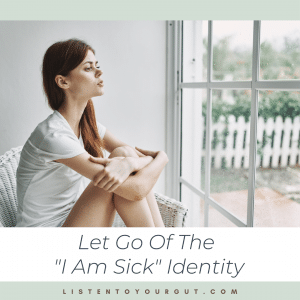
 Are you currently struggling with a chronic illness and/or experiencing everyday symptoms such as pain or fatigue? This can be daunting and stressful for so many reasons, and I can totally relate and see you.
Now, in addition to feeling bad physically, let’s take a step back and observe how you feel emotionally. What’s yours emotional identity?
This is an interesting topic that I want to discuss today as it can exponentially help with healing! 🙂
Our “identity”
Before we delve into the idea of “sick/victim identity,” here’s a great explanation of what our personal identity consists of – and some key points we should consider:
“Personal identity is our concept of how we think about ourselves. While our personal identity is the way we perceive ourselves, our social identity is the way others perceive us. People recognize us by our characteristics in our city, school, career, or other community context.”
Our identity can be shaped by social aspects such as our parents, peers and role models – especially as children. Children often define themselves by how their parents see them. Therefore, it is safe to say that our identity as children initiates a forming process that can be greatly influenced by social interactions – good or bad. While this can be a good “forming experience” under “normal” circumstances, unfortunately when abused, negative beliefs and our core identity (see image below) become severely compromised, instilling a negative identity in us!
The image below shows the series of events that occur when one has or is developing an identity as babies and children:

Core beliefs
If you notice in the picture, right at the heart of it all lies the core. They are also called core beliefs. This amazing PDF from TherapistAid says it best:
“Core beliefs are a person’s most central ideas about themselves, others, and the world. These beliefs act like a lens through which every situation and life experience is viewed. Because of this, people with different core beliefs may find themselves in the same situation, but think, feel, and behave very differently. Even if a core belief is inaccurate, it still shapes the way a person sees the world. Harmful core beliefs lead to negative thoughts, feelings, and behaviors, while rational ones Core beliefs lead to balanced responses.”
Core beliefs are the central part of how we see ourselves and others, so this lens (negative or positive) will influence our life decisions, how we feel, everything!
Facts about core beliefs
• People are not born with core beliefs – they are learned.
• Core beliefs typically develop in childhood or during stressful or traumatic periods in adulthood.
• Information that contradicts core beliefs is often ignored.
• Negative core beliefs are not necessarily true, even if they feel true.
• Core beliefs tend to be rigid and long-standing. However, they can be changed.
Here are 4 Examples of Common Harmful Core Beliefs:

You can easily see how our beliefs have a snowball effect on the way we think, feel, and act. Now most of us do this unconsciously! We don’t even realize that these negative beliefs are crowding out the more positive and beautiful life we could have if we changed the way we think.
The image below shows an example of this Patterns of thoughts, feelings, and behavior based on a core belief:

The “I am sick” identity
So when all of these beliefs are at play, we can (among other things) take on a sick/victim identity. The problem is: How on earth can the body heal once you assume this identity?
Let me explain:
Your body listens to what you tell it. If you continue to identify as a sick person, your body will manifest this – leading to more illness. Any symptom/disease you identify is never good for the body. It’s about memorizing what your body is rather than saying:
“____ is just a temporary thing I may have, but I AM not ____.”
It would be like me saying:
“I suffer from or have ulcerative colitis,” which is about a bond between body and mind.
VS.
“I am currently experiencing symptoms of ulcerative colitis but am working on supporting my body through it.”
What a big difference in that statement, right? Imagine what a difference this makes in your body! A change occurs where your body can now relax and heal knowing that you are supporting it. You may have Crohn’s disease symptoms, but Crohn’s disease does not define who you are. Do you see the difference?
In my blog post on Healing in Layers, I describe specific ailments or illnesses that I struggle with, but I ALWAYS keep in mind that I am not my illness. That’s why I use phrases like:
“I don’t like naming symptoms or my body, but I just wanted to show you how all of these things arose and happened in my body as I worked on treatment…”
Why we identify with illness
To this day, people who knew me as a child still like to refer to me as “the sick girl with colitis” – because that was all they saw for so many years! But after teaching myself how to break through my own sabotage and attachments to illness, I was able to respond politely to these people in a new way.
Once you are aware of this pattern, you will see it in people all the time – and with that usually comes victimhood. It took me a long time to free myself from my shackles, so to speak, because my core beliefs had been so damaged by my life experiences.
Creating a new identity
It may seem impossible to undo the damage done to you by these negative belief systems, but it is definitely possible – and totally worth it!
The first step to creating your desired identity is to truly discover who you are. Who are you without all the negativity that has been instilled in you? This can be scary because when we are so used to an illness/victim belief system, we can become so attached to it that it becomes scary to take on a new identity – even if it is healthier for us.
This is completely normal. Remember that we humans like the familiar. Even if the familiar is unhealthy, we are used to it and can feel comfortable staying in it. I completely understand you! This is a great lazer tapping session with Jini that really helped me process these emotions.
Even when it comes to attachment to illness/sick identity, remember that you are NOT your illness. I encourage you to build on all the other parts of you that are not tied to your illness. Build on your creativity, your passions, your hobbies – what sets your soul on fire? What can you do to feel truly happy and alive? As you do these things, you will develop more self-confidence, which will help you let go of the “I am sick” identity.
Take a step back and think about who you are and who you WANT to be…
Building strong self-confidence
I want to give you four tips that can help you build stronger self-confidence – which in turn can help you listen to your gut feeling:
- Define your values. Values and personal beliefs are fundamental aspects of identity.
- Make your own decisions. Your decisions should primarily benefit your health and well-being.
- Spend time alone.
- Think about how you can achieve your ideals.
You are so much more than your illness, so create the self YOU want to be! And while you have fun finding yourself and creating your new identity, please let me know what you think about this post. Did you find this helpful or inspiring? Is there anything you would like me to write about next? Write a comment below and share it with me!
Until next time – happy healing and remember to always listen to your gut! 🙂
Linsy is Jini’s assistant. From a highly sensitive/reactive case of ulcerative colitis to a fully medical and surgical treatment using all-natural methods, Linsy truly understands first-hand the interplay of mind/body/spirit on the healing journey.
