

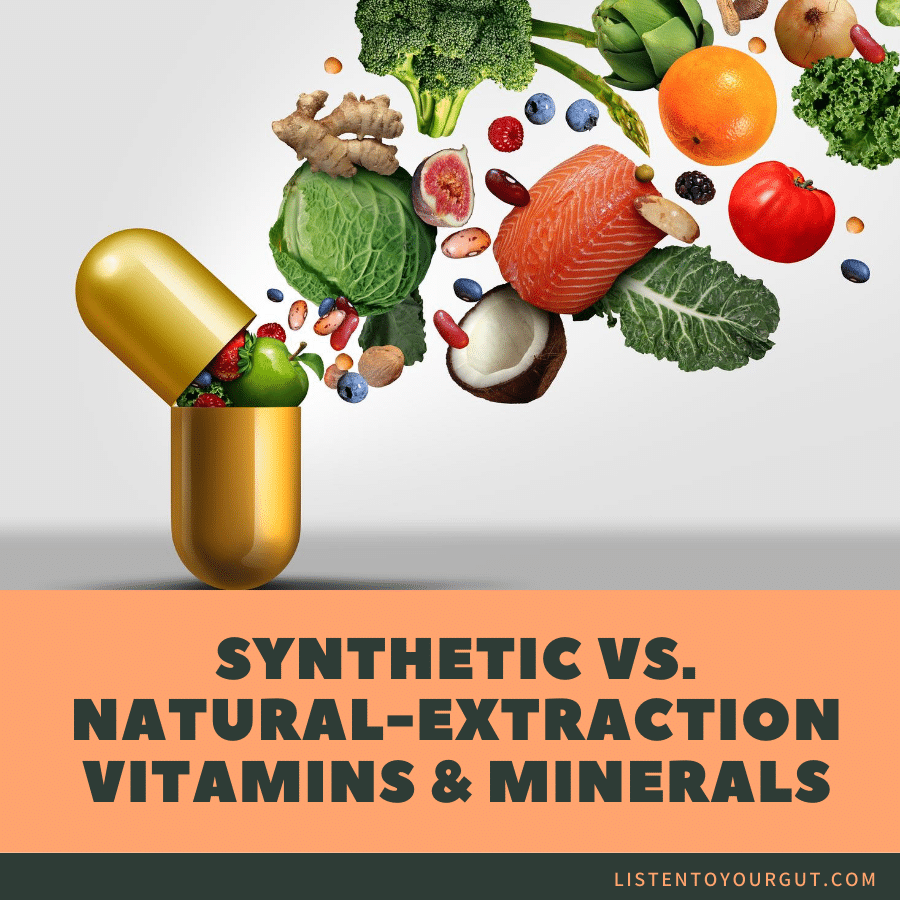
 I’ve had some interesting discussions with people about why I don’t formulate products that contain whole food vitamins. And they also mistakenly believe that products like Absorb Plus contain synthetic vitamins or minerals – because if vitamins aren’t whole foods, they must be synthetic.
First, minerals are rarely (if ever) synthetic because they are relatively inexpensive to extract/refine. Vitamins can be synthetic (pay special attention to vitamin E), but the fact that they are synthetic is often indicated in the nomenclature.
For example:
D-alpha-tocopherol – natural vitamin E
DL-alpha-tocopherol – synthetic vitamin E
L-Proline – Natural amino acid
D-Proline – Synthetic amino acid
All other vitamins are obtained from the entire food or raw material. Some use chemical extraction/filtration processes, others use natural methods such as water, fermentation, steam, etc.
When formulating health products, I only select nutrients from natural sources and naturally extracted nutrients – I obtain the manufacturing flow chart from the raw supplier to verify all filtering/extraction processes.
Sometimes you can get a natural extraction form of the vitamin, but it exists in a matrix of sucrose and synthetic vitamin E, for example (yes, that actually happened). None of these bases are ever listed on a label, and most formulators or manufacturers don’t even know they are part of the vitamin. You will only find out when you request additional documents (beyond the certificate of analysis) from the raw material supplier. This is another reason why I get the entire flow chart from starting material to extraction/fermentation process to finished material.
Does synthetic mean toxic? Not necessarily. It is important to keep in mind that many of the studies demonstrating the beneficial effects of vitamin/min supplementation use synthesized or chemically reacting forms. Maybe because these forms are cheaper or can be patented. But also because whole food forms are not available or not suitable for clinical studies – they are not isolated enough to be able to attribute the effect to a specific substance.
 As you can see with the example of vitamin E, some vitamins/minerals are molecularly identical to the natural form found in foods, others are not. Some can be obtained from natural sources, others cannot (or are not available).
When researching clinical studies on vitamins or minerals, I recommend that you don’t just accept them, but rather look for credible, scientific data to back up each statement. And you must trace the information back to its original data. For example, an article shared on Facebook referenced a study that claimed for the first time that chromium chloride “has negative effects on the reproductive systems of men and women.”
However, in support of this statement, you will notice in the original reference that a distinction is made between trivalent chromium (chromium III) and hexavalent chromium (chromium VI). And the study says that the rats (not humans) were given BOTH for most of the study and they also don’t tell us the weight-based dose. Therefore, we have no way of assessing whether it is about the substance or the dosage. Remember that even consuming too much water can be fatal. But regardless, the NIH database already recognizes that hexavalent chromium is toxic.
But trivalent chromium is a safer form. If you don’t consume chromium as part of your natural dietary intake (it’s found in bananas, potatoes, broccoli, etc.), it must be in an extracted or synthesized (hopefully molecularly identical) form. Of course, it is ideal to have a naturally extracted substance obtained from natural raw material.
There are MANY health gurus on the internet who simply repeat what they have heard elsewhere without ever checking the sources. This happened with bentonite clay for example and I found literally hundreds of websites, doctors and practitioners all repeating the same statement, which turned out to be false. Since it was misquoted at the beginning but no one bothered to check the source study, the incorrect information was quoted again and again. So I wrote a blog post about it to clarify the matter. This is just an example.
As the creator of Absorb Plus – and as someone who has personally used the product for months – I am constantly revising and improving the formula as better forms of the ingredients become available. There is always a balance between the ideal and what is currently available. Another factor, for example, is taste – although a certain shape may be better absorbed, it can also have a very strong taste, making it difficult for children to drink the shake. So in this case I choose the milder form.
 In summary: I’m trying – because don’t forget that I personally consume all of these products myself! – to source as close to nature as possible at this point in time. I hope I have succeeded in making you understand the complexity of product formulation. And when the product has to be elementary, it is even more difficult to juggle between ideal and reality.
And YES, if you can tolerate whole food sources, you should definitely consume them! Here is a blog post I wrote with recipes and ideas.
And did you watch my last teleseminar with Dr. Goldberg – who doesn’t take ANY daily supplements?
I hope this helps and most importantly: listen to your gut feeling! Your gut instinct knows what it needs and what is best for you at that time.

Jini Patel Thompson is an internationally recognized expert in natural healing for digestive diseases. She healed herself from widespread Crohn’s disease and has been medication and surgery free for over 25 years. Jini has appeared on numerous podcasts, TV and radio shows in the US, UK, Canada and Australia, giving people hope and vision on how to heal their colitis, Crohn’s disease, diverticulitis and irritable bowel syndrome (IBS) using all-natural methods. Her books on natural healing of digestive diseases have been sold in over 80 countries worldwide. Jini is married and has three children, nine sheep, 11 horses, a cat and three dogs.
