


 What is rectal prolapse?
So that you know exactly what I’m talking about, let’s first give you an overview of the causes of rectal prolapse. We will then discuss the natural treatment options for rectal prolapse. However, I will also talk about rectocele below – so if that’s the case for you, stick with me.
A rectal or colonic prolapse occurs when the tissue lining the rectum falls into or protrudes from the anal opening. At first it may only appear during bowel movements; then it may protrude when sneezing or other abdominal contractions; Then bulging occurs with activities such as walking, and eventually chronic bulging occurs, in which the rectum does not retract at all.
The following conditions can cause rectal prolapse:
- constipation
- Cystic fibrosis, MS, paralysis
- Malnutrition and malabsorption (example: celiac disease)
- Pinworms (enterobiasis)
- Previous injury to the anus or pelvic area
- Whipworm infection (trichuriasis)
- Anal intercourse – especially if it is long-term or aggressive
- birth
If your rectum has prolapsed, you will likely see a pink or reddish mass of tissue protruding from the opening of the anus, especially after a bowel movement. The lining of the rectal tissue may be visible and bleed easily.
Natural treatment for rectal prolapse
Treating the underlying causes of rectal prolapse usually cures the problem. In otherwise healthy older patients with recurrent rectal prolapse, surgery is sometimes used to correct physical problems that make rectal prolapse more likely to occur. Surgery is also often recommended to treat a rectocele (evagination of the rectum into the vagina).
However, the surgery can cause scar tissue and adhesions that can narrow the rectal canal (anal stenosis) and prevent the rectal and pelvic muscles from relaxing during bowel movements. These two problems can then lead to difficulty passing stools or lead to hemorrhoids or rectal or anal fissures (tears) due to repeated straining.
If this has already happened to you, I have effective natural treatment protocols for all of these conditions. Simply click on the symptom in the list below to look it up:
To treat the underlying conditions that cause or perpetuate rectal prolapse, we must consider a number of possible factors:
1. Painful rectal area
After a colon prolapse, pain can occur in the muscles surrounding the rectum – the levator ani muscle. Applying a hot castor oil pack to these muscles can help relax and soothe them. When you feel the muscles of your sit bones (the “sit bones” that you can feel at the bottom of your buttocks when you sit on a bike or a hard seat) moving on either side of your buttocks and just below your sacrum (the flat, slightly rounded pad of bone at the base of your spine) – you feel the levator ani muscles – this is where you need to apply the castor oil.
The easiest way to do this is to apply cold-pressed castor oil with your fingers in a horseshoe shape from the base of your right sit bone to your tailbone, across your sacrum, and then to the bottom of your left sit bone.
Once you’ve massaged in the castor oil, heat it up. If you have an electric heater, turn it on and kneel in front of it in the “hemorrhoid position”—on your knees and elbows, with your head down and butt in the air—to allow the heat to warm the rectal muscles. Ideally, you should apply heat for 20 to 30 minutes, but even 10 minutes will help.
2. Straining during bowel movements or incorrect bowel position
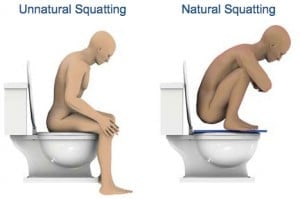 The Western practice of sitting on the toilet prevents the rectum from erecting and opening – making us much more susceptible to prolapse, constipation, hemorrhoids and ruptures! It’s best to squat on the toilet or use a squatting platform like the Squatty Potty that fits around your toilet.
When sitting on the toilet, at least place your feet on a child’s stool to raise your knees higher than your hips. In addition to the video below, check out my videos on constipation positions and self-administered colon massage.
Constipation can play an important role in rectal prolapse and persistent aggravation. Straining or hard stools can tear your rectum (leading to rectal tears) and strain your pelvic muscles. If you suffer from chronic constipation, I highly recommend getting my book, Listen To Your Colon: The Complete Natural Healing Guide For Constipation, as you need a comprehensive constipation treatment that takes all variables into account.
But if your constipation is mild or occasional, then this is for you Natural protocol for treating constipation may be enough to treat it successfully.
Natural Constipation Protocol
- A simple solution to constipation is to take 250 mg of magnesium citrate and 100 mg of potassium citrate at the same time after a good breakfast, lunch or dinner. These two minerals act as a muscle relaxant for the anal sphincter to facilitate bowel movements, while also stimulating your intestinal peristalsis (wavelength muscle contractions) to cause a bowel movement.
- Additionally, take 7 to 10 billion CFU (colony forming units) of Natren brand probiotics daily to begin the process of normalizing your intestinal flora (1 capsule of Healthy Trinity per day).
- You will also need to use a stool softener once or twice a day at the same time to keep your stool soft and reduce stress and pressure on the rectum. You can use psyllium, chia, or flaxseed to soften or bulk up your stool – or you can use the products I’ve put together with my ideal blend of ingredients in my preferred forms:
ColonEaze~Firm – if you suffer from diarrhea
ColonEaze~Move – if you are prone to constipation
NOTE: If you eat an exclusively elemental diet, you cannot use stool softeners – only if you combine Absorb Plus with normal food. - Remember to drink 8 to 10 glasses of filtered or spring water daily.
3. Weakened, stretched or traumatized pelvic muscles and rectocele
If you apply gentle pressure to the muscles closest to the area where your rectum protrudes when you have a bowel movement, you may be able to keep the rectum in and prevent it from coming out with the stool.
Childbirth or prolonged constipation during heavy exertion can also lead to a condition known as rectocele – in which the walls between the vagina and rectum become thinner and/or stretched. When this happens, your rectum may protrude into your vagina, preventing straight bowel movements. In this video, you’ll learn some great techniques you can use for both of these conditions:
Squatting on the toilet or using a squatting platform like the Squatty Potty is the ideal way to easily reach your perineum (the area between the rectum and vagina in women and between the rectum and scrotum in men) and the rectal muscles (levator ani), which are located on either side of your rectum and in a horseshoe shape up to your tailbone (the end of your tailbone).
NOTE: Don’t squat directly on the toilet unless you have a very solid porcelain toilet that you know can support your body weight. Check load capacity with your toilet manufacturer to be sure.
Keep a box of surgical gloves (available at any pharmacy) in your bathroom so you can become familiar with your rectal muscles and perineum without fear of your hands coming into contact with feces.
Body therapy
The anorectal canal is surrounded by muscles and ligaments, with the pudendal nerve passing through these muscles. After surgery, childbirth or any type of trauma or prolonged stress, muscle, tendon or ligament strains in the corresponding tissues or organs can occur. This strain and weakening of the muscles and ligaments can lead to rectal prolapse.
The other option to heal the underlying cause of your prolapse is through body therapy by a doctor specifically trained to work in this area. Be sure to tell them that you have rectal prolapse and ask them to look specifically at the levator ani muscle, sacrum, coccyx, and pudendal nerve.
You’ll likely get the best results from an osteopathic doctor or physical therapist trained in myofascial release techniques. Look for chiropractors, osteopaths or physical therapists (called physical therapists in Canada) who are trained in ART (Active Release Technique) or John F. Barnes’ myofascial release and myofascial relaxation techniques.
NATURAL TREATMENT FOR RECTAL PROLAPSE – SUMMARY
Fill out the form below and I’ll send you my free e-book “Jini’s Healing Guide For Rectal Prolapse” with detailed instructions for all of these natural rectal prolapse remedies:
Original post May 2012. Last updated August 2022.

Jini Patel Thompson is an internationally recognized expert in natural healing for digestive diseases. She healed herself from widespread Crohn’s disease and has been medication and surgery free for over 25 years. Jini has appeared on numerous podcasts, TV and radio shows in the US, UK, Canada and Australia, giving people hope and vision on how to heal their colitis, Crohn’s disease, diverticulitis and irritable bowel syndrome (IBS) using all-natural methods. Her books on natural healing of digestive diseases have been sold in over 80 countries worldwide. Jini is married and has three children, nine sheep, 11 horses, a cat and three dogs.
